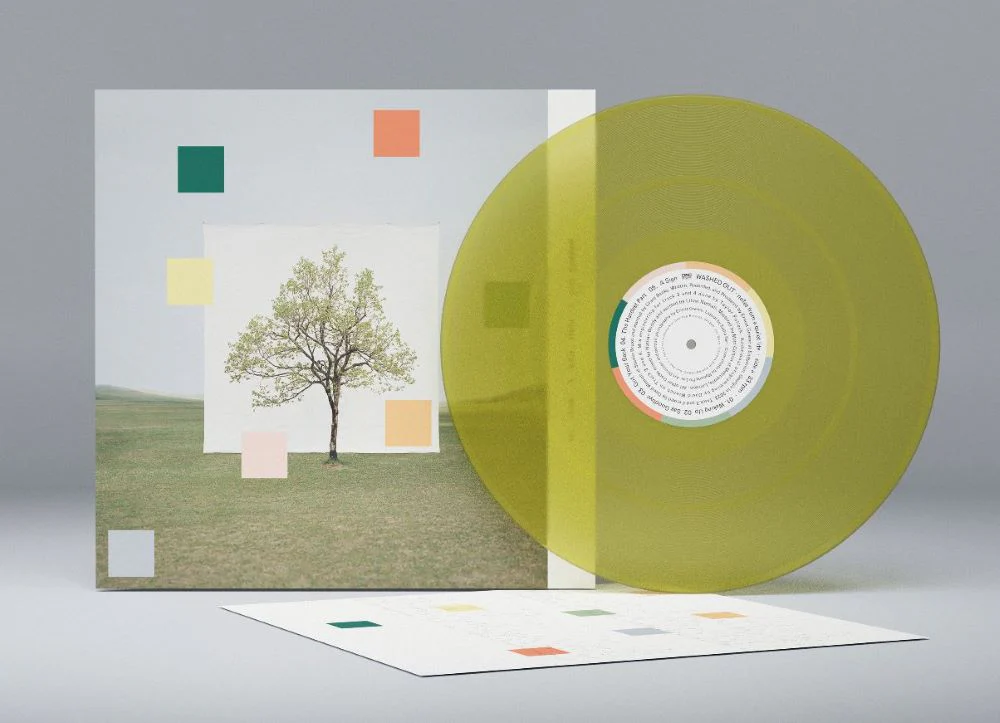
Washed Out Notes from a Quiet Life Vinyl LP Indies Yellowy Green Colour 2024
1. Waking Up
2. Say Goodbye
3. Got Your Back
4. Hardest Part
5. A Sign
6. Second Sight
7. Running Away
8. Wait on You
9. Wondrous Life
10. Letting Go
The music of Washed Out has always levitated over a timeless frontier. You can sense it in his immersive, amorphous vocals, the expansive soundscapes, the wistful storytelling. It’s a sweet spot where, says its creative force, Ernest Greene, “any sort of association or memory from the past can transport you instantly. I love that.”
Greene’s transcendent output has earned him the moniker of “Godfather of Chillwave” by Pitchfork and a co-sign from Portlandia, which borrowed his track, “Feel It All Around,” for its utopian theme song. His latest, Notes From a Quiet Life arrives after delivering more than a decade of distinct and disparate creative re-imaginations at a remarkably high level (five albums, two EPs). Notes is bold in its intuitiveness: Greene has left the treadmill of music-as-a-business, instead letting his artistic
interests lead the way. “Each album,” says Green, who also paints and sculpts, “is a world-building exercise.”
The Georgia native left Atlanta in 2021 to move back to the countryside he knew growing up. Where escapism once flooded his thoughts, today he is preoccupied with the universe of wonder in the reality around him. He named the former horse farm he moved to “Endymion” (after the pastoral John Keats poem about a lovesick shepherd — its opening line: “A thing of beauty is a joy for ever”), and it has shaped all that he’s created there, from his music to his albums’ creative direction to his planned large scale visual-art experiments.
“I’ve read that every five, maybe 10, years, you’re practically a different person — like literally, on a cellular level,” Greene explains. “The things that you’re going through will end up changing you, and
you’re kind of a different person. This album is a reflection of that. Experimenting with painting and sculpture helps my music. They influence each other. That was a kind of realization for me. I don’t
want to look back on my life one day, and be like, ’Oh, it was all about maximizing productivity,’” he says. “I want to enjoy this.”
That purity of vision is what makes Notes From a Quiet Life so potent. It’s the first album Greene wholly self-produced, with some mixing assistance from Nathan Boddy (James Blake, Mura Masa) and David Wrench (Caribou, Florence + the Machine). “Early in my career, I had a lack of technical skill, and there were some things I wasn’t 100% enthusiastic about,” he says, noting Jean-Michel Basquiat’s distinct, self-driven method as an inspiration. “Something that I was looking for was...I didn’t want any illusion of anyone else’s influences. I wanted to see this through to the end. And honestly, that was a big challenge.
Illustrating that, Greene’s list of influences for Notes From a Quiet Life are mostly sculpture icons: minimalist legend Donald Judd, abstract expressionist Cy Twombly, and modernists Barbara Hepworth and Henry Moore. Of the latter, he observes, “The majority of his working life was spent on his country estate, and he wasn’t living a cosmopolitan lifestyle. He was focused on just making good work, you know?”
Original: $32.21
-65%$32.21
$11.27Washed Out Notes from a Quiet Life Vinyl LP Indies Yellowy Green Colour 2024
1. Waking Up
2. Say Goodbye
3. Got Your Back
4. Hardest Part
5. A Sign
6. Second Sight
7. Running Away
8. Wait on You
9. Wondrous Life
10. Letting Go
The music of Washed Out has always levitated over a timeless frontier. You can sense it in his immersive, amorphous vocals, the expansive soundscapes, the wistful storytelling. It’s a sweet spot where, says its creative force, Ernest Greene, “any sort of association or memory from the past can transport you instantly. I love that.”
Greene’s transcendent output has earned him the moniker of “Godfather of Chillwave” by Pitchfork and a co-sign from Portlandia, which borrowed his track, “Feel It All Around,” for its utopian theme song. His latest, Notes From a Quiet Life arrives after delivering more than a decade of distinct and disparate creative re-imaginations at a remarkably high level (five albums, two EPs). Notes is bold in its intuitiveness: Greene has left the treadmill of music-as-a-business, instead letting his artistic
interests lead the way. “Each album,” says Green, who also paints and sculpts, “is a world-building exercise.”
The Georgia native left Atlanta in 2021 to move back to the countryside he knew growing up. Where escapism once flooded his thoughts, today he is preoccupied with the universe of wonder in the reality around him. He named the former horse farm he moved to “Endymion” (after the pastoral John Keats poem about a lovesick shepherd — its opening line: “A thing of beauty is a joy for ever”), and it has shaped all that he’s created there, from his music to his albums’ creative direction to his planned large scale visual-art experiments.
“I’ve read that every five, maybe 10, years, you’re practically a different person — like literally, on a cellular level,” Greene explains. “The things that you’re going through will end up changing you, and
you’re kind of a different person. This album is a reflection of that. Experimenting with painting and sculpture helps my music. They influence each other. That was a kind of realization for me. I don’t
want to look back on my life one day, and be like, ’Oh, it was all about maximizing productivity,’” he says. “I want to enjoy this.”
That purity of vision is what makes Notes From a Quiet Life so potent. It’s the first album Greene wholly self-produced, with some mixing assistance from Nathan Boddy (James Blake, Mura Masa) and David Wrench (Caribou, Florence + the Machine). “Early in my career, I had a lack of technical skill, and there were some things I wasn’t 100% enthusiastic about,” he says, noting Jean-Michel Basquiat’s distinct, self-driven method as an inspiration. “Something that I was looking for was...I didn’t want any illusion of anyone else’s influences. I wanted to see this through to the end. And honestly, that was a big challenge.
Illustrating that, Greene’s list of influences for Notes From a Quiet Life are mostly sculpture icons: minimalist legend Donald Judd, abstract expressionist Cy Twombly, and modernists Barbara Hepworth and Henry Moore. Of the latter, he observes, “The majority of his working life was spent on his country estate, and he wasn’t living a cosmopolitan lifestyle. He was focused on just making good work, you know?”
Product Information
Product Information
Shipping & Returns
Shipping & Returns
Description
1. Waking Up
2. Say Goodbye
3. Got Your Back
4. Hardest Part
5. A Sign
6. Second Sight
7. Running Away
8. Wait on You
9. Wondrous Life
10. Letting Go
The music of Washed Out has always levitated over a timeless frontier. You can sense it in his immersive, amorphous vocals, the expansive soundscapes, the wistful storytelling. It’s a sweet spot where, says its creative force, Ernest Greene, “any sort of association or memory from the past can transport you instantly. I love that.”
Greene’s transcendent output has earned him the moniker of “Godfather of Chillwave” by Pitchfork and a co-sign from Portlandia, which borrowed his track, “Feel It All Around,” for its utopian theme song. His latest, Notes From a Quiet Life arrives after delivering more than a decade of distinct and disparate creative re-imaginations at a remarkably high level (five albums, two EPs). Notes is bold in its intuitiveness: Greene has left the treadmill of music-as-a-business, instead letting his artistic
interests lead the way. “Each album,” says Green, who also paints and sculpts, “is a world-building exercise.”
The Georgia native left Atlanta in 2021 to move back to the countryside he knew growing up. Where escapism once flooded his thoughts, today he is preoccupied with the universe of wonder in the reality around him. He named the former horse farm he moved to “Endymion” (after the pastoral John Keats poem about a lovesick shepherd — its opening line: “A thing of beauty is a joy for ever”), and it has shaped all that he’s created there, from his music to his albums’ creative direction to his planned large scale visual-art experiments.
“I’ve read that every five, maybe 10, years, you’re practically a different person — like literally, on a cellular level,” Greene explains. “The things that you’re going through will end up changing you, and
you’re kind of a different person. This album is a reflection of that. Experimenting with painting and sculpture helps my music. They influence each other. That was a kind of realization for me. I don’t
want to look back on my life one day, and be like, ’Oh, it was all about maximizing productivity,’” he says. “I want to enjoy this.”
That purity of vision is what makes Notes From a Quiet Life so potent. It’s the first album Greene wholly self-produced, with some mixing assistance from Nathan Boddy (James Blake, Mura Masa) and David Wrench (Caribou, Florence + the Machine). “Early in my career, I had a lack of technical skill, and there were some things I wasn’t 100% enthusiastic about,” he says, noting Jean-Michel Basquiat’s distinct, self-driven method as an inspiration. “Something that I was looking for was...I didn’t want any illusion of anyone else’s influences. I wanted to see this through to the end. And honestly, that was a big challenge.
Illustrating that, Greene’s list of influences for Notes From a Quiet Life are mostly sculpture icons: minimalist legend Donald Judd, abstract expressionist Cy Twombly, and modernists Barbara Hepworth and Henry Moore. Of the latter, he observes, “The majority of his working life was spent on his country estate, and he wasn’t living a cosmopolitan lifestyle. He was focused on just making good work, you know?”